Frida Kahlo: Making Her Self Up
It’s quite surreal to be able to visit an exhibition of an artist whom you have long admired but never seen the works in person. This colourful persona is more complex than you might imagine. As you walk through the well curated space of the V&A you are enlightened about the early life of the artist, leaving little else to the imagination. There are themes of pain and struggles, entwined with hope, strength and an infinite curiosity about self, society and identity. This exhibition, which is for the first time presented in the UK, showcases personal items as well as art works and photographs of Frida and her close family. You get the privilege of getting acquainted with the artist herself through her make up, plaster corset and even love letters.
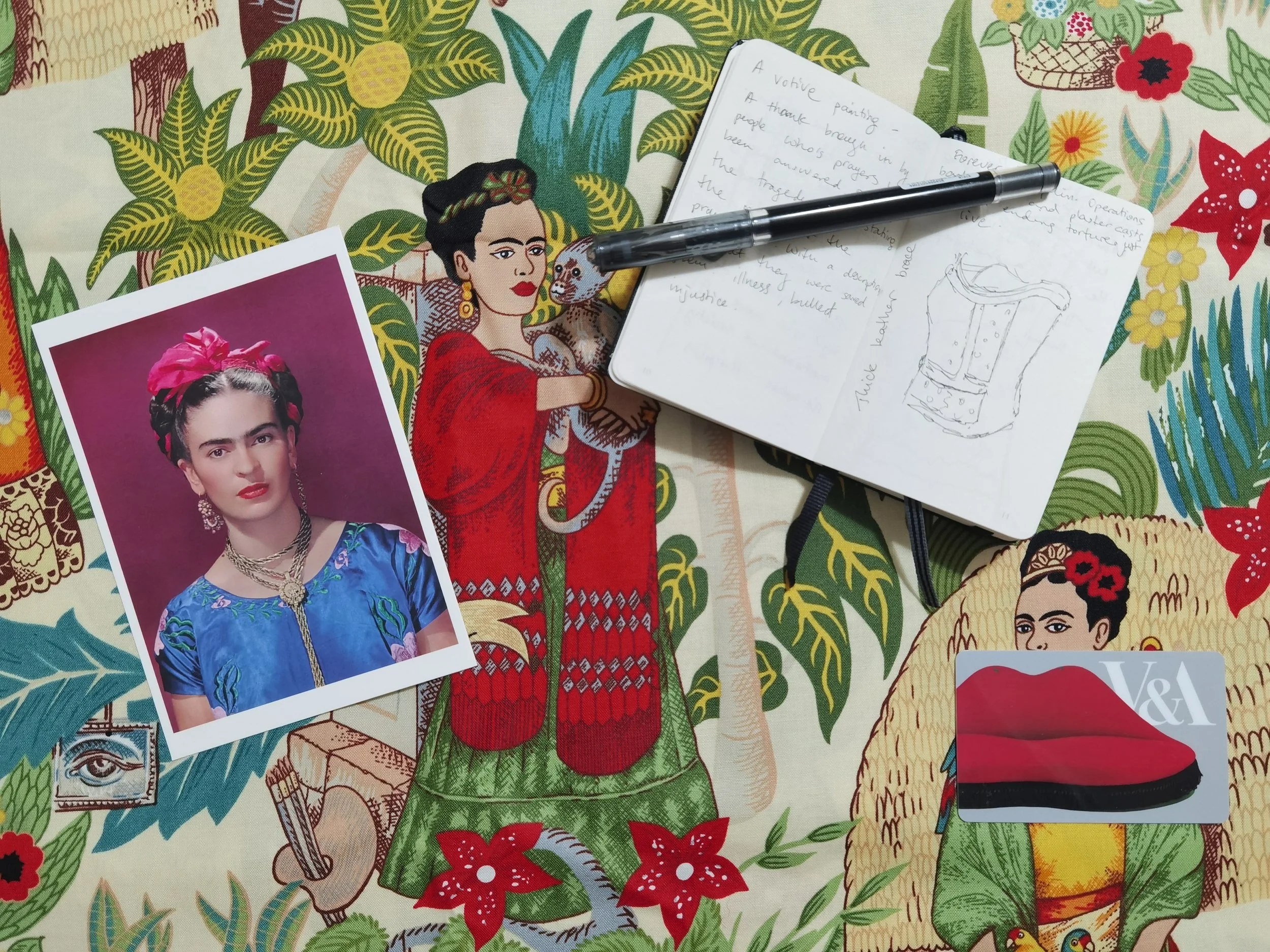
The exhibition did not permit photography so what follows are my observations and little notes and sketches I have made along the way. Some images from the exhibition can be view from the V&A website here.
In 2004 Frida Kahlo’s room in the Blue House in Mexico City, was opened up for the first time in 50 years since her passing, such was her personal wish. What was discovered was a time capsule, a moment frozen in time as if the artist had only stepped out for a minute. Inclosed were 6,000 photographs, 22,000 documents, cosmetics and clothes to name only a few.
The first room of the exhibition is devoted to early life of Kahlo and her family. Born in 1907 Coyoacan, Mexico, to a German father with Hungarian roots and a Mexican mother of Spanish and Native American heritage, she was the third daughter of four. When she was just six, she contacted Polio, which is a viral disease that affects the nervous system, often affecting the legs and respiratory muscles. Frida’s right leg was affected causing her to limp after her recovery. However this did not hinder her in the slightest. She had a very close relationship with her father who was a photographer and she would often help him in his work. You could imagine an impressionable young woman developing a keen eye for detail and composition. However she did not choose the life path of a photographer or an artist at this stage. Frida was a select few of females who attended the National Preparatory School in Mexico City in 1922 to study science and eventually medicine. This is where she first meets Diego Rivera, a renown Mexican muralist who was working on a mural at the school called The Creation.
Frida Kahlo was known to be opinionated and outspoken; it is inspiring to learn that despite her hardships she did not succumb to the darkness of despair and depression. In fact Kahlo is remembered for the very opposite. Her colourful and hopeful portraits and yes I include her paintings with the theme of death for they are not depicting a gruesome finality but beauty of life lived. But I’m getting ahead of myself, let’s go back to the first room of the exhibition. What stuck with me the most was how supportive her family was of Frida. How forward thinking she was and how unoppressed she was by those around her, for early 20th century still a rarity. There is a black and white photo of the Kahlo family where Frida is wearing a man’s suite looking very much like a young man rather than a typical young woman of the time. A fine line between wearing trousers for comfort and ease, and crossdressing.
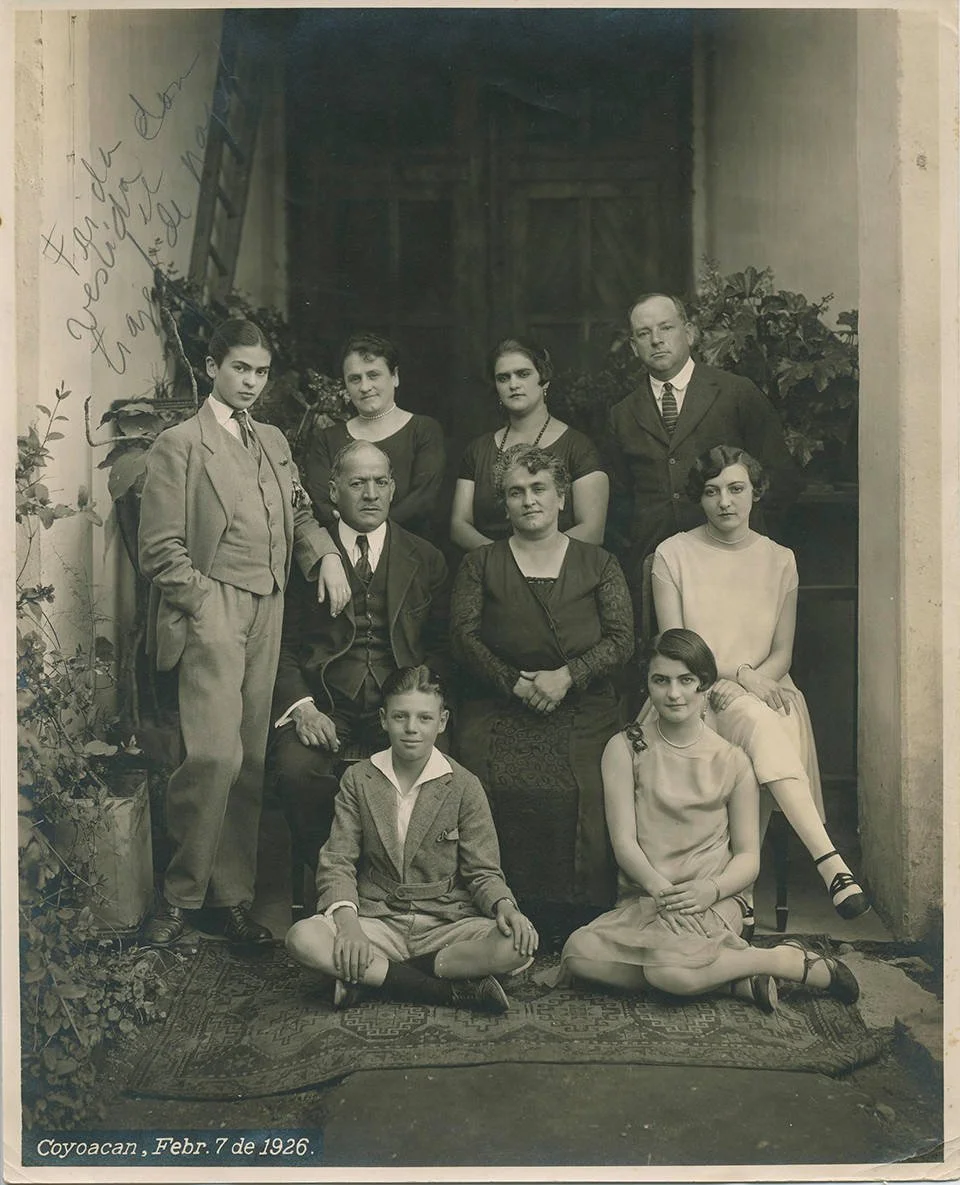
The Kahlo Calderón family (with Frida standing on the left), by Guillermo Kahlo, 7 February 1926, Coyoacán, Mexico. © The Vicente Wolf Collection
In 1925 was the year of Frida’s near fatal crash. She was riding a bus from her school when it collided with another vehicle. Her right leg was crushed and a steel handrail had impaled her through her hip causing serious damage to her abdomen and uterus amongst fractures in her spine, ribs, collarbone and pelvis. A horrific accident which left Frida with a lifetime of pain and an altered destiny.
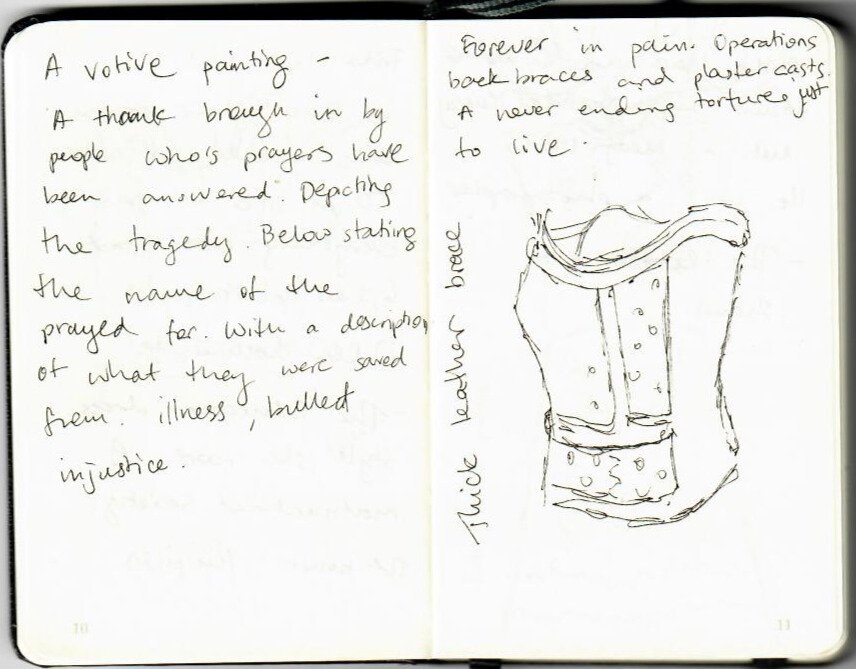
After returning home from the hospital to continue her recuperation wearing a body brace and being forced to stay in bed, her parents encouraged her to draw. This is the beginning of Frida Kahlo as we know her. One of her back braces was on display as well as her prosthetic leg, which she wore after amputating her leg from gangrene in 1953. Both items very ornate and vibrant. The second room where these items and other personal effects were displayed was my favourite from the entire exhibition. Just as Kahlo was leaning towards her Mexican heritage after her marriage to Diego Rivera so was the exhibition. On display you could find photographs of the Zapotec women in the Tehuana dress, which Frida adopted to wear herself. It consisted of a skirt and tunic called Huipil with various bright colours and pattern combinations. An entire wall was dedicated to display votive paintings. Those were little thank yous to saints for bringing about and answering the peoples prayers. Many had the depiction of the tragedy, below stating the description from what they were saved from; illness, bullet, injustice. All very personal little snippets into ones personal life.
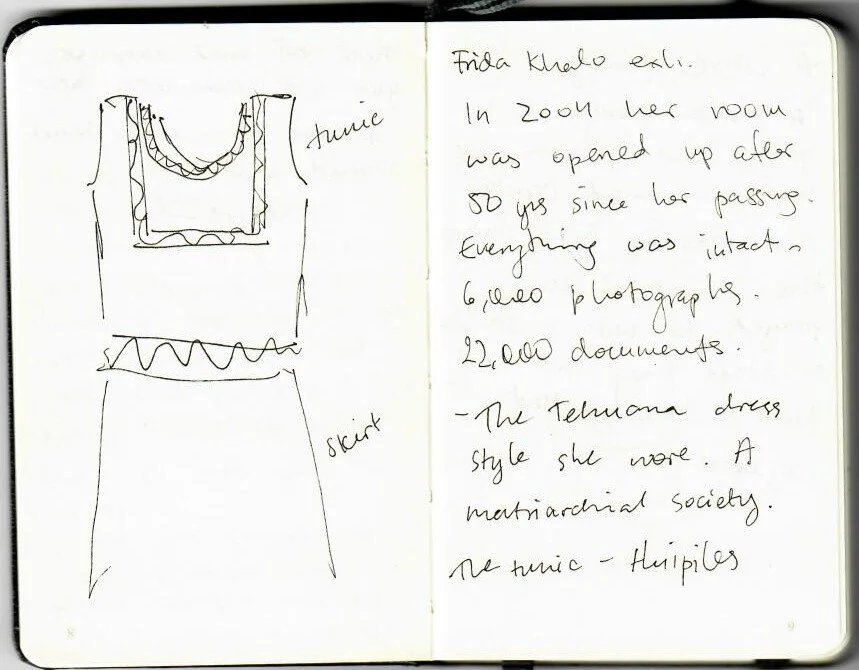
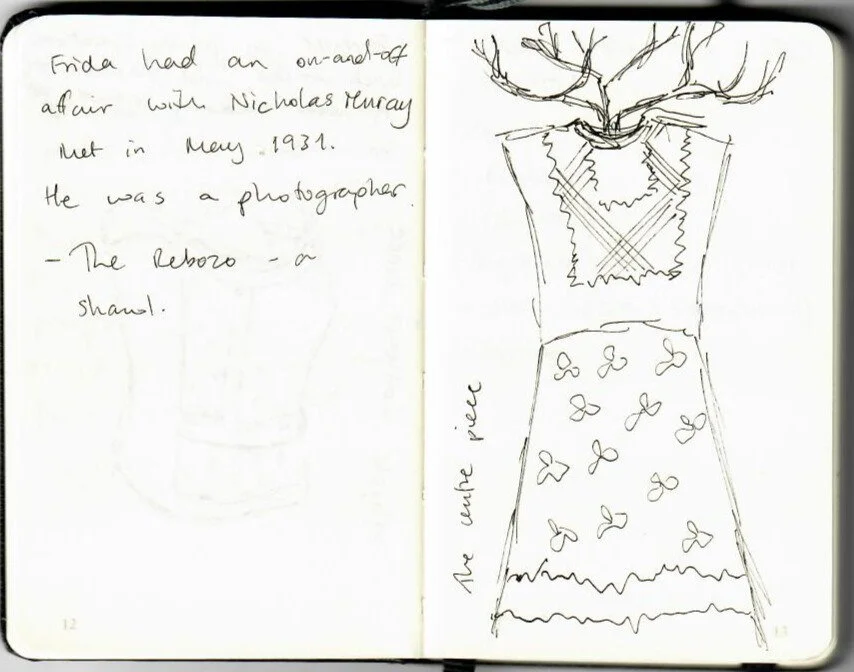
Entering the largest room of the exhibition, you are met with a grandiose display of Frida’s cultural dress style, which she liked to wear so much in her later years. The colourful tunics and skirts were certainly impressive and left you breathless as you entered the room. Incased in the middle of the room with one of the centre pieces having a sculpture design of what looks like a tree or maybe roots, I presume to mean ‘family roots’. On the surrounding dark wall the majority of Kahlo’s paintings from the exhibition tell a story of her search for her identity. Each painting becoming more confident in who she was.
In the end I’d like to believe that she was unapologetically herself. Flawed yet passionate, determined and sympathetic. Leaving the exhibition left me with complex feelings, which took me a moment to decipher. It was a bit like removing rose tinted glasses and seeing the world which was the same as before only different, where there were more vivid colours. With this revelation you see everything more clearly. I stopped romanticising the artist as I discovered more about the woman behind. I may not agree with her lifestyle or with the affairs she had (each to their own and Diego Rivera was far from a saint himself) but understanding the human behind the work makes me admire her all the more.
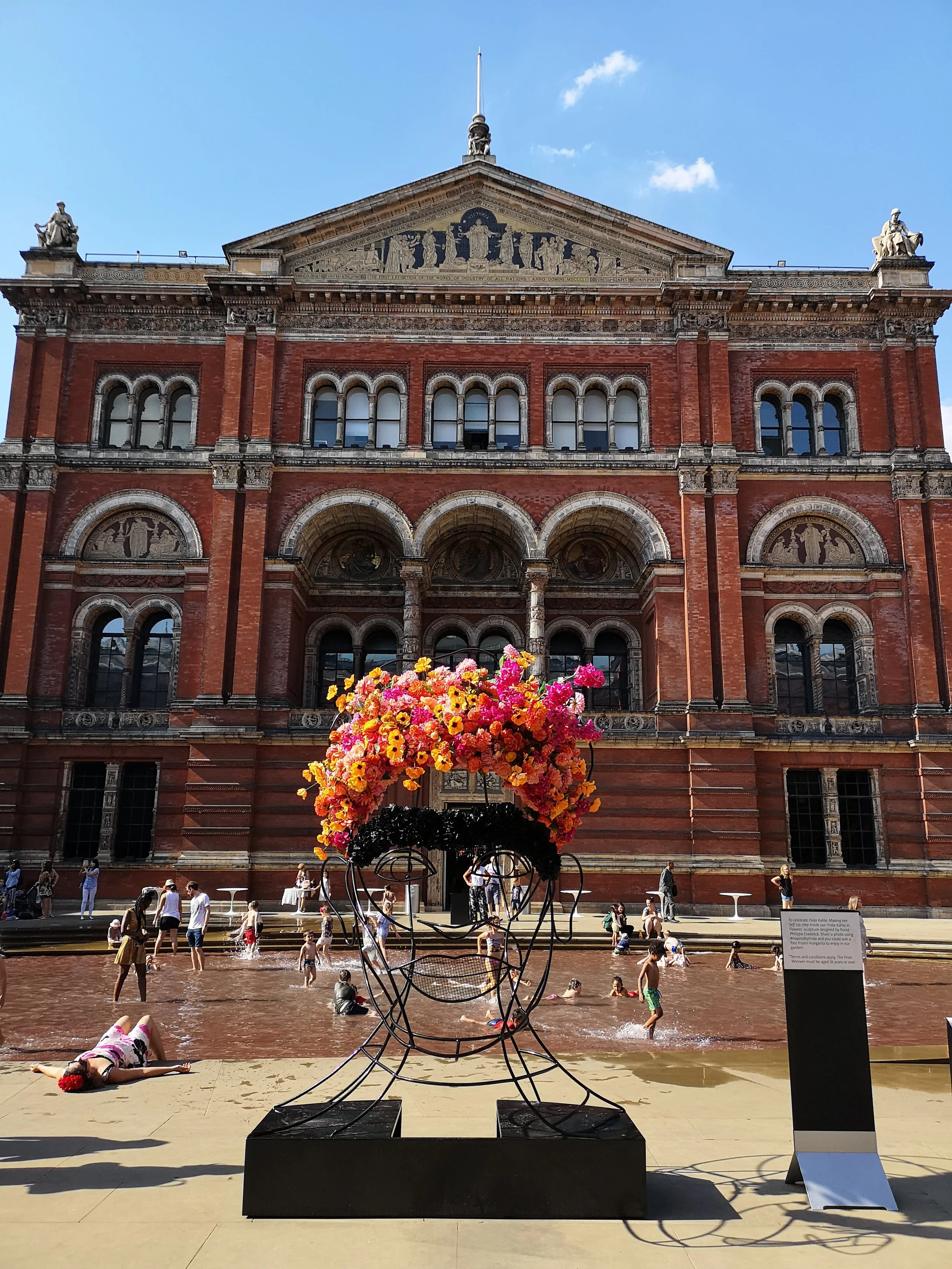
V&A Courtyard decorated for the Frida Kahlo: Making Her Self Up exhibition.
Frida Kahlo: Making Her Self Up at the Victoria and Albert Museum, South Kensington.
16 June 2018 - 18 November 2018